
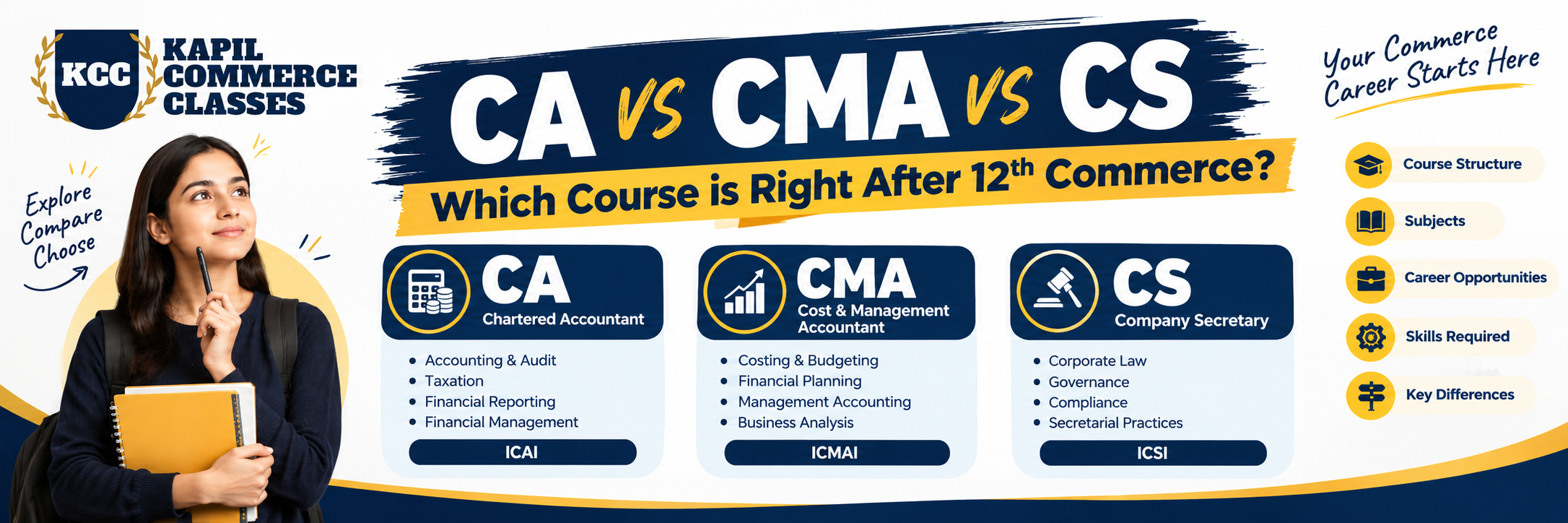
For students from the commerce stream, choosing a professional course after Class 12 can be an important career decision. Among the most recognised options are CA (Chartered Accountancy), CMA (Cost and Management Accountancy), and CS (Company Secretary).
Although all three are professional qualifications, they focus on different areas of business and commerce. CA is more closely connected with accounting, auditing, and taxation; CMA focuses on costing, financial planning, and management accounting, while CS is primarily related to corporate law, governance, and compliance.
Therefore, when comparing CA vs CMA vs CS, students should not simply look at which course is more popular. The better approach is to understand the nature of each course and see how well it matches your interests, strengths, and long-term career plans.
If you are searching for a CA vs CMA vs CS comparison or wondering which professional course is right after 12th commerce, this guide will help you understand the key differences.
What Are CA, CMA and CS?
What is CA?
CA stands for Chartered Accountant. It is a professional qualification that focuses extensively on accounting, auditing, taxation, financial reporting, and financial management.
Students pursuing CA study subjects that help them understand how businesses maintain financial records, comply with taxation requirements, conduct audits, and analyse financial performance. After qualifying, CA professionals may work with accounting firms, consulting organisations, corporate finance departments or establish their own professional practice, depending on their experience and eligibility.
The CA course is conducted by the Institute of Chartered Accountants of India (ICAI). Its main stages include Foundation, Intermediate, and Final. Eligible graduates may also have access to the direct-entry route to Intermediate under the applicable ICAI rules.
What is CMA?
CMA stands for Cost and Management Accountant. The course focuses on understanding business costs, budgeting, financial planning, performance analysis, and management decision-making.
While CMA also involves accounting and finance, its approach is more closely connected with how financial information can be used to control costs, improve profitability, and support business decisions. This makes the qualification particularly relevant in organisations where budgeting, cost management and performance measurement play an important role.
The course is conducted by the Institute of Cost Accountants of India (ICMAI) and generally includes Foundation, Intermediate and Final stages. Eligible graduates and certain other candidates may enter directly at the Intermediate level as per applicable rules.
What is CS?
CS stands for Company Secretary. Compared with CA and CMA, the CS course has a stronger focus on corporate law, company regulations, governance, compliance and secretarial practices.
A Company Secretary helps organisations understand and comply with various corporate and regulatory requirements. The profession may involve areas such as company law, statutory documentation, corporate governance, board procedures, and regulatory compliance.
The CS course is conducted by the Institute of Company Secretaries of India (ICSI). The programme primarily consists of Executive and Professional stages, while the applicable entry route depends on a student's educational qualification.
CA vs CMA vs CS: Basic Comparison
The three qualifications may overlap in certain business and financial areas, but their primary professional focus remains different.
CA vs CMA vs CS: Course Structure
The course structure is another factor students should understand before making a decision.
CA
The CA pathway generally moves from Foundation to Intermediate and then Final. Students may enter Intermediate through the Foundation route or through applicable direct-entry provisions. CA preparation involves significant study in accounting, taxation, auditing, law, financial reporting and financial management.
CMA
The CMA pathway also generally includes Foundation, Intermediate and Final. In addition to academic examinations, applicable skills and practical training requirements may form part of the qualification process. The course is particularly relevant for students interested in costing, budgeting, cost control and financial analysis.
CS
The CS pathway mainly includes the Executive and Professional programmes. The entry route depends on the student's educational qualifications. Students joining after 10+2 follow the applicable initial route, while eligible graduates may enter at the Executive level. The curriculum places considerable emphasis on company law, corporate governance, regulatory matters and compliance.
Since eligibility requirements, examination structures and training conditions may change, students should always check the latest information provided by ICAI, ICMAI and ICSI before registering.
Difference Between CA, CMA and CS Subjects
Subjects can give students one of the clearest indications of which course may suit them.
In CA, students study areas related to accounting, taxation, auditing, business laws, financial reporting, financial management and strategic management. Students who enjoy working with financial statements, accounting problems, taxation and audit-related concepts may find CA more aligned with their interests.
CMA includes financial and cost accounting, cost management, financial management, business economics, budgeting, performance management and strategic decision-making. Students who are interested in analysing business costs, understanding profitability and using financial information for decision-making may find CMA particularly relevant.
The CS curriculum is more law-oriented. It includes areas such as company law, corporate governance, legal compliance, corporate and economic laws, secretarial practices, and corporate restructuring. Students who enjoy reading laws, interpreting regulations, and understanding corporate procedures may feel more comfortable with CS.
If your main interest is accounting, auditing, and taxation, CA has a strong connection with these areas. Much of the CA curriculum and professional work revolves around financial statements, tax, audit, and financial reporting.
CMA also includes substantial accounting knowledge, but its focus moves more towards cost accounting, management accounting, budgeting, and using financial information to support business decisions.
CS is considerably different because accounting is not its central area. It focuses more strongly on corporate law, governance and compliance.
Therefore, instead of simply asking which course is better for accounting, students should identify whether they are more interested in financial reporting and audit, cost and management accounting, or corporate law and compliance.
CA vs CMA vs CS: Which Course Is Better for Finance?
All three qualifications can connect with the broader corporate environment, but they interact with finance differently.
CA is closely associated with financial reporting, taxation, audit, accounting, and financial management. CMA focuses heavily on budgeting, financial planning, cost control, profitability analysis and business performance.
CS professionals generally work more closely with regulatory compliance, corporate governance and company law rather than core accounting or financial analysis.
Students who enjoy analysing numbers, costs and business performance may be more interested in CMA. Those interested in financial reporting, taxation and auditing may explore CA, while students attracted to law, regulations and corporate compliance may find CS more relevant.
Career Opportunities After CA, CMA and CS
Career opportunities can vary considerably depending on the qualification, industry, experience and additional skills of a professional.
A qualified CA may work in auditing, taxation, accounting, financial analysis, consulting and corporate finance. Opportunities can be available with accounting firms, companies, consulting organisations and finance departments. Some qualified professionals may also pursue independent practice subject to applicable professional requirements.
A CMA may work in areas related to cost accounting, budgeting, financial planning, cost management, business analysis, financial management and performance management. The qualification can be particularly useful in manufacturing and service organisations where cost control and profitability analysis are important.
A CS can build a career around corporate compliance, company law, corporate governance, legal and corporate advisory, statutory documentation and regulatory compliance. The role can be especially important for organisations that need professional support in meeting company law and governance requirements.
CA vs CMA vs CS: Which Course Is Suitable After 12th Commerce?
Commerce students can consider all three qualifications after Class 12, but the best direction depends on individual interests.
If accounting, taxation, financial statements, and auditing interest you, CA may be worth exploring. If you enjoy costing, budgeting, numerical analysis, and understanding how businesses improve financial performance, CMA may align more closely with your interests.
On the other hand, students who enjoy law, rules, regulations, governance and corporate procedures may find CS more suitable.
Your commerce background can provide a useful foundation, but your stream alone should not decide your professional course. Your academic strengths, learning preferences and long-term career plans are equally important.
Skills Required for CA, CMA and CS
Every professional course requires discipline, consistency and the ability to understand complex concepts, but the type of skills used can differ.
CA students generally benefit from strong accounting fundamentals, numerical ability, analytical thinking, attention to detail and problem-solving skills. Since taxation and law also form an important part of the course, the ability to understand technical rules and apply them correctly can be valuable.
For CMA, numerical ability, logical thinking, and financial understanding are important. Students also benefit from being comfortable with cost analysis, business performance, budgeting, decision-making, and interpreting financial information.
CS students usually need strong reading and comprehension skills because a significant portion of the course deals with law and regulations. Attention to detail, communication, analytical thinking, and the ability to understand corporate documentation can also be helpful.
These skills do not need to be perfect before beginning a course. Many of them can be developed through structured preparation and regular practice.
CA vs CMA vs CS: How to Choose?
There is no single answer to “CA vs CMA vs CS: which is better?” because each qualification prepares students for a different professional area.
A student interested in accounting, auditing, taxation, and financial reporting may naturally lean towards CA. Someone interested in costing, budgeting, financial analysis and business performance may find CMA more appropriate. A student who prefers corporate law, governance, compliance and regulatory matters may be more interested in CS.
Before making the final decision, students should also review the current syllabus, exam structure, eligibility conditions, training requirements and career opportunities associated with each qualification.
Most importantly, avoid choosing a professional course only because your friends or relatives are pursuing it. The course should match the type of subjects you enjoy and the professional work you can see yourself doing in the future.
Why Professional Course Preparation Matters
CA, CMA, and CS are professional qualifications that require consistent preparation and a strong understanding of concepts. Simply memorising information may not always be enough, particularly as students progress to advanced levels.
A structured preparation approach can help students maintain a regular study schedule, understand difficult concepts, practise examination-oriented questions and revise subjects effectively.
For students in Jaipur looking for commerce-focused professional course preparation, Kapil Commerce Classes (KCC) provides coaching for CA, CMA and CS along with other commerce programmes. The institute states that it offers online, offline and recorded learning options with a focus on conceptual clarity and examination preparation.
The preparation strategy can also vary by course and level. Foundation students generally need to build strong fundamentals, while students preparing for Intermediate, Executive, Final or Professional levels require deeper subject understanding, regular revision and focused examination practice.
Final Thoughts: CA vs CMA vs CS
Choosing between CA, CMA and CS is an important decision for commerce students, but the choice becomes easier once you understand what each qualification primarily focuses on.
CA is closely connected with accounting, auditing, taxation and financial reporting. CMA focuses more strongly on cost and management accounting, budgeting, financial analysis and business decision-making. CS, meanwhile, revolves around corporate law, governance, compliance and regulatory responsibilities.
Instead of asking only “CA vs CMA vs CS which is better?”, ask yourself what subjects you genuinely enjoy, what type of work interests you and what kind of professional role you would like to build in the future.
Understanding these differences can help you make a more informed decision about your professional course.
For students looking for CA, CMA, or CS coaching in Jaipur, Kapil Commerce Classes offers professional course preparation with different learning options for students preparing for their